
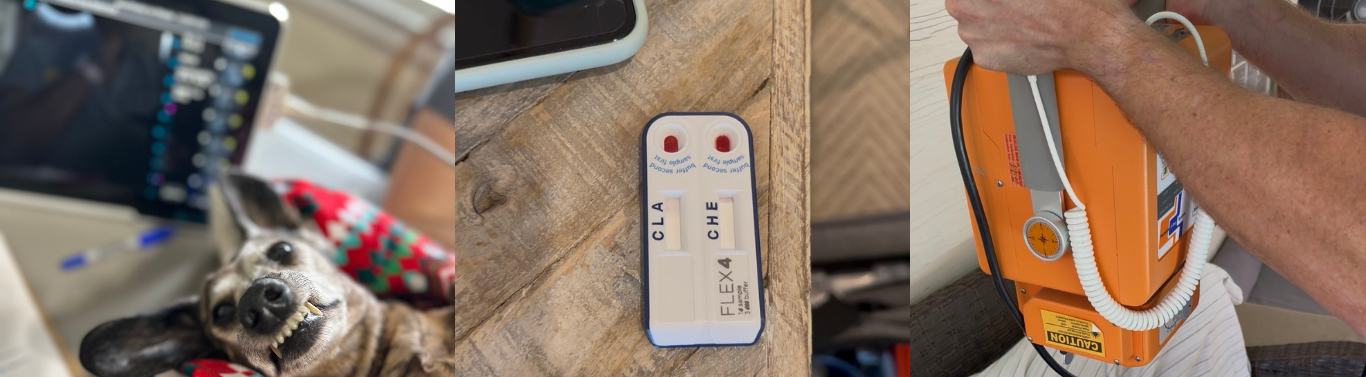
Diagnostic testing plays a critical role in veterinary medicine. Because pets cannot tell us where something hurts or what feels different, diagnostics help veterinarians look beneath the surface to understand what’s really going on.
At WoofDoctor on Wheels, many essential diagnostic services can be performed during an in-home visit. This allows us to gather meaningful medical information while keeping pets calm, comfortable, and in a familiar environment — often improving both the quality of the exam and the experience for the pet.
This guide explains which diagnostics WoofDoctor on Wheels offers, how they support your pet’s care, and when referral to a hospital or specialty service may be recommended.
Read More About
- Why Diagnostics Matter
- Diagnostic Services Offered by WoofDoctor on Wheels
- Diagnostic Imaging at Home: X-Rays & Ultrasound
- Laboratory Diagnostics at Home
- Why In-Home Diagnostics Matter for Accuracy & Comfort
- How Diagnostics Work at WoofDoctor on Wheels
- When Referral or Advanced Diagnostics Are Needed
- Where Can I Learn More?
Why Diagnostics Matter
Diagnostics help guide nearly every medical decision we make. At WoofDoctor on Wheels, diagnostic testing allows us to:
- Identify illness early, sometimes before symptoms are obvious
- Confirm or rule out suspected conditions
- Monitor chronic disease over time
- Establish baseline health values as pets age
- Ensure treatments and anesthesia are as safe as possible
We use diagnostics intentionally, recommending testing when it adds value to your pet’s care and helps inform next steps.
Diagnostic Services Offered by WoofDoctor on Wheels
WoofDoctor on Wheels is equipped to perform a wide range of diagnostic services during in-home visits. These tools allow us to evaluate many common concerns without requiring a separate clinic trip.
Depending on your pet’s needs, diagnostics we commonly offer include:
- Blood work to evaluate organ function, infection, inflammation, and metabolic health
- Urinalysis to assess kidney function and urinary health
- Fecal testing to screen for intestinal parasites
- Heartworm and infectious disease testing
- Blood pressure monitoring, especially important for senior pets and cats
- Cytology, such as skin or ear samples to evaluate infection or inflammation
- Xray & ultrasound to evaluate bones, joints, and internal organs when indicated
- Histopathology, providing microscopic evaluation of tissue samples
- Thermal Imaging, Non-invasive imaging that helps identify inflammation or potential problem areas
These diagnostics often allow us to make informed treatment decisions during the same visit, reducing delays in care.
Diagnostic Imaging at Home: X-Rays, Ultrasound & Thermal Imaging
X-Rays (Radiographs)
When indicated, WoofDoctor on Wheels can perform X-rays during an in-home visit. Radiographs help evaluate:
- Bones and joints, including arthritis or suspected injury
- Chest structures such as the lungs and heart size
- Abdominal organs for foreign bodies, bladder stones, or masses
X-rays are especially useful for orthopedic concerns, trauma, respiratory issues, and gastrointestinal symptoms.
Ultrasound Imaging
Ultrasound allows us to evaluate soft tissues and organs in real time and may be used to assess:
- Abdominal organs such as the liver, spleen, kidneys, and bladder
- Fluid accumulation in the abdomen or chest
- Certain masses or organ changes
- Pregnancy confirmation when appropriate
- Evaluate heart structure and function
Ultrasound is non-invasive and does not use radiation, making it a useful diagnostic tool when clinically appropriate.
Thermal Imaging
Thermal imaging allows us to evaluate surface heat patterns and circulation changes and may be used to assess:
- Areas of inflammation or irritations
- Musculoskeletal strain or injury
- Real- time tracking of pain or inflammatory response
- Areas that may require further diagnostic evaluation
Thermal imaging is non-invasive and does not use radiation, making it a useful screening tool. It requires your pet to simply stand still for a moment and does not involve any physical contact.
Laboratory Diagnostics At Home
Laboratory testing is one of the most powerful tools in veterinary medicine. Blood, urine, and fecal testing allow veterinarians to evaluate internal organ function, detect infection or inflammation, and identify changes that may not be visible on physical exam alone.
At WoofDoctor on Wheels, we are able to perform many essential laboratory diagnostics during in-home visits, providing the same foundational medical insight you would expect from a traditional veterinary clinic. These tests support wellness screening, illness evaluation, pre-anesthetic planning, and ongoing monitoring of chronic conditions.
Common laboratory diagnostics we perform include:
- Complete blood counts (CBC) to evaluate red and white blood cells*
- Blood chemistry panels to assess liver, kidney, and metabolic function*
- Urinalysis to evaluate kidney health and urinary tract conditions
- Fecal testing to screen for intestinal parasites*
- Heartworm and infectious disease testing
- Tick-borne disease testing
- Allergy testing, when appropriate, to help investigate chronic itching, skin disease, or recurrent ear infections*
- Cancer screening tests, when indicated, to help assess cancer risk or support early detection as part of a broader diagnostic plan*
Performing laboratory testing during your visit allows us to review results, explain findings, and discuss next steps with you in real time whenever possible. This keeps care efficient, collaborative, and focused on clear, informed decision-making.
Tests marked with an asterisk (*) are sent to our reference laboratory. These labs have specialized equipment that allows for more detailed testing.
Why In-Home Diagnostics Matter for Accuracy & Comfort
One of the greatest advantages of in-home diagnostics is the ability to gather meaningful medical information while pets remain calm, comfortable, and in familiar surroundings. Stress can influence behavior, vital signs, and even some diagnostic results. By bringing diagnostic tools directly to your home, we are often able to perform more thorough exams, obtain more reliable measurements, and create a calmer experience for both pets and their families.
Mobile diagnostics are not just about convenience. They are about creating the right conditions for accurate evaluation, thoughtful decision-making, and compassionate care.
Reduced Stress Supports Better Medical Insight
When pets feel anxious or overwhelmed, their bodies activate a stress response that can temporarily elevate heart rate, respiratory rate, and blood pressure. Veterinary research has shown that these stress-related changes are more common in clinic environments than in the home, particularly for cats and anxious dogs.
Evaluating pets where they feel safe helps minimize these stress responses. A calmer pet is easier to examine, more cooperative during testing, and more likely to show their true baseline health. This allows veterinarians to interpret findings with greater confidence and avoid mistaking stress-related changes for underlying disease.
Bringing Diagnostics to Your Pet, Not the Other Way Around
For many pets, the most difficult part of diagnostic testing is not the test itself, but the process of getting to the clinic. Car rides, unfamiliar smells, slick floors, loud noises, and physical handling can be especially challenging for pets that are anxious, painful, large, or mobility-limited.
By bringing tools like digital X-ray and ultrasound directly to your home, we can often perform necessary diagnostics without forcing pets through an experience that increases fear or discomfort. Severely anxious pets may tolerate imaging more easily in a quiet, predictable environment. Senior pets and those with arthritis or neurological conditions can remain resting comfortably rather than being lifted, re-positioned, or asked to stand on unfamiliar surfaces.
This approach prioritizes comfort and dignity while still allowing us to gather the information needed to guide care.
A More Natural Picture of Your Pet’s Health
In-home diagnostics allow veterinarians to see pets as they truly are, not just how they behave in a stressful clinic setting. Observing a pet’s movement, posture, breathing, and behavior in their normal environment provides valuable context that cannot always be captured elsewhere.
This natural snapshot of daily life can reveal subtle mobility changes, pain, or behavioral cues that influence diagnostic interpretation and treatment planning. When combined with laboratory testing and imaging, this context helps ensure recommendations are better aligned with your pet’s real needs and lifestyle.
Clearer Communication & Collaborative Decision-Making
Another important benefit of in-home diagnostics is the opportunity for open, unhurried communication. Because we are right outside your door, pet parents can remain present and informed throughout the diagnostic process.
We take the time to explain what we are seeing, review results together, and discuss options in a relaxed, collaborative way. This transparency helps families feel confident in next steps and actively involved in care decisions, rather than rushed or uncertain.
For many pet parents, this communication transforms diagnostics from a stressful moment into a reassuring plan.
Especially Helpful for Pets Who Struggle with Traditional Visits
While in-home diagnostics benefit many pets, they can be particularly helpful for those who find traditional veterinary visits challenging, including:
- Pets with severe anxiety or fear of clinics
- Senior pets or those with mobility limitations
- Cats who experience significant stress with transport and unfamiliar environments
By minimizing stress and physical strain, mobile diagnostics make it easier for these pets to receive the care they need without added distress.
A Calmer Experience That Supports Better Care
Ultimately, in-home diagnostics support what matters most: accurate information, thoughtful decision-making, and a positive experience for pets and their families. By reducing stress, improving comfort, and prioritizing communication, mobile veterinary diagnostics allow us to deliver the same medical insight you would expect from a traditional clinic, in a way that feels calmer, more personal, and better aligned with your pet’s well being.
How Diagnostics Work at WoofDoctor on Wheels
In-Home Laboratory Testing
When Is Lab Work Recommended?
Laboratory testing is tailored to your pet’s individual needs, but it plays an essential role in both preventive care and medical diagnosis.
We commonly recommend lab work for:
- Pre-operative screening (required for all surgeries)
- Annual or baseline wellness testing
- Senior pet monitoring
- Investigating symptoms like vomiting, lethargy, or weight changes
Even in healthy pets, baseline bloodwork helps us detect early changes in organ function—often before symptoms appear.
We also perform in-home screening tests like the 4DX test, which checks for:
- Heartworm disease
- Lyme disease (Borrelia)
- Ehrlichia
- Anaplasma
This quick, low-stress test requires only a few drops of blood.
What Samples Are Collected?
Diagnostics are always patient-specific, but may include:
- Blood samples for routine and advanced testing
- Urine samples for kidney health or urinary concerns
- Fecal samples when parasites or GI issues are suspected
- Cytology or fine needle aspirates (FNA) for masses or skin conditions
We only recommend what your pet actually needs; no unnecessary testing.
How Testing Works Behind the Scenes
Samples are collected by our trained technician team and carefully prepared based on the type of test. Some samples are processed immediately, while others are securely stored and sent to a trusted reference laboratory for detailed analysis.
When Will You Get Results?
Most lab results are available within 2–4 days, though specialized tests may take longer.
Once results are in:
- Dr. Cifranick reviews everything thoroughly
- You receive a detailed, easy-to-understand summary via email
- You also get a copy of the full lab report
If needed, we’ll schedule time to walk through results and next steps together.
In-Home X-Ray (Digital Radiography)
When Are X-Rays Needed?
X-rays help us evaluate structural issues and are often recommended for:
- Limping or mobility issues that don’t improve
- Suspected injuries or fractures
- Coughing or breathing concerns
- Abdominal abnormalities
- Changes in organ size or shape
How Mobile X-Rays Work
We bring high-quality digital X-ray equipment directly to your home and perform imaging in our mobile unit.
Your pet is gently positioned for accurate imaging, and in many cases:
- Sedation is not required
- The process is quick and well tolerated
If needed, mild sedation may be used for comfort and safety.
What X-Rays Can Diagnose
X-rays are especially useful for evaluating:
- Bones and joints (arthritis, fractures)
- Heart and lungs (heart disease, pneumonia)
- Abdomen (blockages, organ changes)
- Certain cancers and masses
How Results Are Interpreted
Dr. Cifranick reviews images immediately and discusses findings with you in real time.
If additional insight is needed, images can be sent to a board-certified radiologist for further evaluation.
What Happens Next?
X-ray findings help us:
- Narrow down possible diagnoses
- Determine if treatment can begin right away
- Decide if further diagnostics (like ultrasound or specialist referral) are needed
In-Home Ultrasound
When Is Ultrasound Recommended?
Ultrasound is the best tool for evaluating soft tissues and organ function.
It’s commonly used to assess:
- Liver, spleen, and kidneys
- Bladder and urinary tract
- Gastrointestinal tract
- Heart (echocardiography)
- Fluid or internal abnormalities
What Ultrasound Can (and Can’t) Do
Ultrasound provides detailed, real-time imaging of internal structures and movement.
It can:
- Identify abnormalities like masses or fluid
- Evaluate organ structure and function
It cannot:
- Definitively diagnose what a mass is without further testing
- Effectively evaluate air-filled or bony structures like lungs or spine
What to Expect During an In-Home Ultrasound
Ultrasounds are scheduled in advance and performed in your home by our licensed veterinary technician team.
To ensure accurate results:
- Pets are typically fasted beforehand
- A small area may be shaved
- A calm, quiet environment is ideal
Some pets may benefit from mild sedation to help them remain still during the procedure.
How Results Are Reviewed
All ultrasound images are sent to a board-certified radiologist, with results typically returned within 24 hours.
Dr. Cifranick then:
- Reviews the findings
- Provides a detailed explanation
- Recommends next steps
How Ultrasound Guides Treatment
Because ultrasound shows real-time organ function, it helps us quickly determine whether your pet needs:
- Medical treatment
- Additional diagnostics (like biopsy)
- Dietary or lifestyle changes
- Referral to a specialist
- Ongoing monitoring
When Referral or Advanced Diagnostics Are Needed
While WoofDoctor on Wheels offers comprehensive in-home diagnostics, some cases require advanced testing or hospital-based care. This may include:
- CT or MRI imaging
- Specialty or advanced ultrasound studies
- Emergency diagnostics
- Conditions requiring overnight hospitalization or intensive monitoring
In these situations, mobile care plays an important role as the first step. Our diagnostics help determine when referral is needed and allow us to communicate clearly with referral partners so your pet receives the appropriate level of care without unnecessary delays.
A Thoughtful, Personalized Approach to Diagnostics
At WoofDoctor on Wheels, diagnostics are never one-size-fits-all. Every recommendation is based on your pet’s individual needs, comfort, and overall health picture.
By combining thorough physical exams with in-home laboratory testing and diagnostic imaging, including X-rays and ultrasound when appropriate, we are able to deliver high-quality medical insight in a way that feels calmer, more personal, and better aligned with your pet’s well-being.
Where Can I Learn More?
Read more about:
- How We Structure Pricing: Mobile Veterinary Care Pricing
- How You Can Pay for Your Pet’s Surgery Using Our Care Plans
- More Benefits of Mobile Veterinary Care
About The Author

This blog was written by Dr. Doug Cifranick, MVB, founder of WoofDoctor on Wheels. Dr. Cifranick has been practicing veterinary medicine in Beaufort, South Carolina since 2015 and launched WoofDoctor on Wheels in 2022 to provide high-quality, low-stress care in pets’ homes. He also serves as co-chair of The Veterinary Cooperative, where he helps support and advocate for independent veterinary practices.
If you would like to schedule an appointment with Dr. Cifranick, please call or text us at (843) 966-3362. You may also schedule an appointment online.
More About WoofDoctor on Wheels
WoofDoctor on Wheels is a mobile veterinary practice providing high-quality, compassionate care right in the comfort of your home. By eliminating car rides and waiting rooms, mobile care reduces stress for pets and allows for more personalized, unhurried visits for the pets under our care.
We proudly serve pet families throughout the Lowcountry, including Beaufort, Bluffton, Hilton Head, and more. You can view our full service area here.
We provide all the standard care you would expect from a traditional veterinary clinic, including preventive exams, vaccinations, diagnostics, in-house lab testing, sick visits, end-of-life services, and more. We also offer surgical services such as spay and neuter, dental cleanings, and more. Learn more about our services here.
To learn more about how mobile veterinary care works with WoofDoctor on Wheels, visit here.
Our Mission
Our goal is simple: make veterinary care more accessible, less stressful, and better aligned with your pet’s real-life needs. Our blog allows us to share important educational content. To support our efforts, this page may contain affiliate links. If you make a purchase after using them, we earn a small commission, which helps support this blog at no cost to you. Keep in mind, we only link to quality products we use ourselves and feel are beneficial for our clients and patients.
References
Show All References
Abbott, J. A. (2005). Heart rate and heart rate variability of healthy cats in home and hospital environments. Journal of Feline Medicine and Surgery. https://journals.sagepub.com/doi/10.1016/j.jfms.2004.12.003?url_ver=Z39.88-2003&rfr_id=ori:rid:crossref.org&rfr_dat=cr_pub%20%200pubmed
American Animal Hospital Association. (2016). AAHA end-of-life care guidelines. Journal of the American Animal Hospital Association, 52(6), 341–356. https://doi.org/10.5326/JAAHA-MS-6510
American Animal Hospital Association. (2022). AAHA canine vaccination guidelines. Journal of the American Animal Hospital Association, 58(5), 213–227. https://www.aaha.org/wp-content/uploads/globalassets/02-guidelines/2022-aaha-canine-vaccination-guidelines/resources/2022-aaha-canine-vaccinations-guidelines.pdf
American Association of Feline Practitioners. (2020). 2020 AAFP feline vaccination advisory panel report. Journal of Feline Medicine and Surgery, 22(9), 813–830. https://doi.org/10.1177/1098612X20941784
American Association of Feline Practitioners. (2020). 2020 AAFP–AAHA feline vaccination guidelines. American Association of Feline Practitioners. https://www.aaha.org/resources/2020-aahaaafp-feline-vaccination-guidelines/
American Animal Hospital Association. (2016). AAHA end-of-life care guidelines. Journal of the American Animal Hospital Association, 52(6), 341–356. https://www.aaha.org/resources/2016-aaha-iaahpc-end-of-life-care-guidelines/
American Veterinary Medical Association. (2018). U.S. pet ownership and demographics sourcebook. AVMA. https://ebusiness.avma.org/files/ProductDownloads/eco-pet-demographic-report-22-low-res.pdf
American Veterinary Medical Association. (2024). Shared decision-making in veterinary medicine. Journal of the American Veterinary Medical Association, 263(1). https://avmajournals.avma.org/view/journals/javma/263/1/javma.24.06.0421.xml
Beerda, B., Schilder, M. B. H., van Hooff, J. A. R. A. M., de Vries, H. W., & Mol, J. A. (1997). Manifestations of chronic and acute stress in dogs. Applied Animal Behaviour Science, 52(3–4), 307–319. https://doi.org/10.1016/S0168-1591(96)01131-8
Bragg, R. F., Bennett, J. S., Cummings, A., & Quimby, J. M. (2015). Evaluation of the effects of hospital visit stress on physiologic variables in dogs. Journal of the American Veterinary Medical Association. https://www.researchgate.net/publication/270287984_Evaluation_of_the_effects_of_hospital_visit_stress_on_physiologic_variables_in_dogs
Caney, S. M. A., Robinson, N. J., Gunn-Moore, D. A., & Dean, R. S. (2022). Happy cats: Stress in cats and their carers associated with outpatient visits to the clinic. Journal of Feline Medicine and Surgery, 24(12), e551–e557. https://doi.org/10.1177/1098612X221121907
Day, M. J. (2007). Immune system development in the dog and cat. Journal of Comparative Pathology, 137(Suppl 1), S10–S15. https://doi.org/10.1016/j.jcpa.2007.04.005
Day, M. J., Carey, S., Clercx, C., Kohn, B., Marsilio, F., Thiry, E., & Priestnall, S. L. (2020). Aetiology of canine infectious respiratory disease complex and prevalence of its pathogens in Europe. Veterinary Record, 186(5), 150. https://pmc.ncbi.nlm.nih.gov/articles/PMC7103302/
Day, M. J., Horzinek, M. C., Schultz, R. D., & Squires, R. A. (2016). WSAVA guidelines for the vaccination of dogs and cats. Journal of Small Animal Practice, 57(1), E1–E45. https://doi.org/10.1111/jsap.12431
Dhabhar, F. S. (2014). Effects of stress on immune function: The good, the bad, and the beautiful. Immunology and Allergy Clinics of North America, 34(2), 339–353. https://link.springer.com/article/10.1007/s12026-014-8517-0
Dodds, W. J. (2021). Early life vaccination of companion animal pets. Frontiers in Veterinary Science. https://www.ncbi.nlm.nih.gov/pmc/articles/PMC7910975/
Griffin, F. C., Mandese, W. W., Reynolds, P. S., Deriberprey, A. S., Blew, A. C., & Hill, K. E. (2020). Evaluation of clinical examination location on stress in cats: A randomized crossover trial. Journal of Feline Medicine and Surgery, 23(4), 364–369. https://doi.org/10.1177/1098612X20959046
Groves, C. N. H., Coe, J. B., Sutherland, K. A., Bauman, C., & Grant, L. E. (2024). Clients prefer collaborative decision-making with veterinarians regardless of appointment type. Journal of the American Veterinary Medical Association, 263(1), 1–11. https://doi.org/10.2460/javma.24.06.0421
Gyles, C. (2009). Infection control in veterinary clinics. Canadian Veterinary Journal, 50(4), 339–344. https://www.ncbi.nlm.nih.gov/pmc/articles/PMC2657513/
Horwitz, D. F. (2018). Behavioral awareness in the feline consultation. Journal of Feline Medicine and Surgery. https://www.ncbi.nlm.nih.gov/pmc/articles/PMC11395291/
International Association for Animal Hospice and Palliative Care. (2019). Guidelines for hospice and palliative care in veterinary medicine.
Landsberg, G. M., Hunthausen, W., & Ackerman, L. (2013). Behavior problems of the dog and cat (3rd ed.). Saunders Elsevier.
Monteiro, B. P., & Steagall, P. V. (2019). Chronic pain in cats: Recent advances in clinical assessment. Journal of Feline Medicine and Surgery, 21(7), 601–614. https://journals.sagepub.com/doi/10.1177/1098612X19856179?url_ver=Z39.88-2003&rfr_id=ori:rid:crossref.org&rfr_dat=cr_pub%20%200pubmed
Priestnall, S. L., Mitchell, J. A., Walker, C. A., Erles, K., & Brownlie, J. (2014). New and emerging pathogens in canine infectious respiratory disease. Veterinary Pathology, 51(2), 492–504. https://doi.org/10.1177/0300985813511130
Quimby, J. M., Smith, M. L., & Lunn, K. F. (2011). Evaluation of the effects of hospital visit stress on physiologic parameters in the cat. Journal of Feline Medicine and Surgery. https://journals.sagepub.com/doi/10.1016/j.jfms.2011.07.003
Rodan, I., Sundahl, E., Carney, H., Gagnon, A. C., Heath, S., Landsberg, G., Seksel, K., & Yin, S. (2011). AAFP and ISFM feline-friendly handling guidelines. Journal of Feline Medicine and Surgery, 13(5), 364–375. https://doi.org/10.1016/j.jfms.2011.03.012
Stull, J. W., Bjorvik, E., Bub, J., Dvorak, G., Petersen, C., & Troyer, H. (2015). 2015 AAHA infection control, prevention, and biosecurity guidelines. Journal of the American Veterinary Medical Association, 246(5), 532–541. https://www.aaha.org/wp-content/uploads/globalassets/02-guidelines/infection-control/icpb_guidelines.pdf